

The Swiss textile machinery in Turkmenistan's forced labour system
Tim Wirth, November 10, 2026
 ©
opak.cc
There is one man whom the CEOs and executives of Swiss textile machinery manufacturers have recently been particularly eager to shake hands with: Nurmuhammet Orazgeldiyev. He comes from Turkmenistan, the isolated Central Asian country regarded as one of the world’s most repressive dictatorships and often compared with North Korea. His title: Minister of Textiles.
In May 2025,Orazgeldiyev visited a plant operated by the Swiss group Saurer in Germany. “Saurer looks forward to continued collaboration with the Turkmen Ministry of Textiles as we work together to strengthen global partnerships and drive innovation in the industry,” the company wrote on Linkedin, adding the hashtag #GlobalPartnership.
Just one month later, the Minister of Textiles travelled to Rapperswil in Switzerland to visit Graf & Cie AG, a subsidiary of Rieter, a long-established Swiss company. A photograph shows him with CEO Frrok Prenka. According to a company press release, the highlight of the visit was the signing of a “Memorandum of Understanding”. It continued: “With this agreement, Graf reaffirms its commitment to supporting the dynamic growth of Turkmenistan’s yarn industry.”
This January, Orazgeldiyev attended the Heimtextil trade fair in Frankfurt, where he met representatives of Rieter. A photograph from the event shows him beside a sales specialist from the Swiss group. On X, Rieter wrote that its sales team and the Turkmen delegation had discussed “the current spinning market environment and opportunities in this evolving market”.
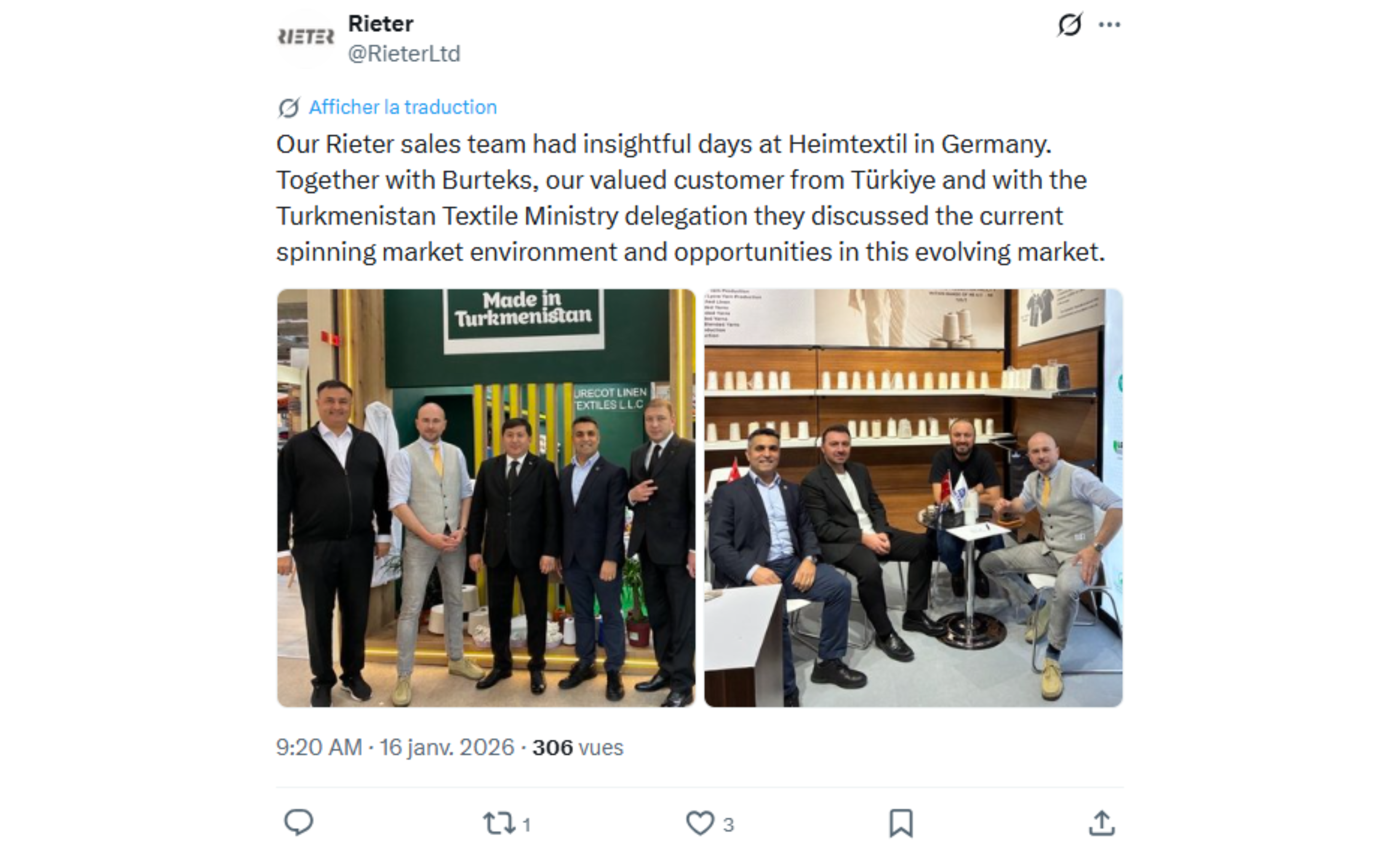
Three handshakes. On one side, Turkmenistan, which wants to expand its textile industry and relies on modern machinery to do so. On the other, Swiss industrial groups seeking growth in new markets.
Alongside Rieter and Saurer, the Swiss companies Uster Technologies, Benninger and Stäubli also sell textile machinery and equipment to Turkmenistan. So much for #GlobalPartnership. In Turkmenistan’s case, however, this means doing business with a dictatorship – and accepting that the machinery will process cotton harvested by Turkmen people under forced labour.
A recent report by several international human rights organisations starkly illustrates what this means. Every year, the Turkmen state forces its citizens to pick tonnes of cotton in inhumane conditions. A new study by the International Labour Organization (ILO), which surveyed 1,611 cotton pickers last year, confirms the report’s key findings.
Women and children particularly at risk
Ruslan Myatiev is the editor of Turkmen.news, one of the very few media outlets that report freely on Turkmenistan. He lives in exile in the Netherlands. “During the cotton harvest, Turkmen people literally serve as slaves,” Myatiev told Public Eye. The government uses them as unpaid labour, he says. “And when state-owned companies then use machinery from Swiss firms to manufacture and export textiles, the dictator’s family keeps all the profits. The people receive nothing.”
Turkmen.news is one of the organisations in the Cotton Campaign Coalition that produced the report on forced labour in Turkmenistan. All are based outside the country because the Turkmen state controls every aspect of public life and deliberately targets activists and journalists who criticise the government.
According to the report, Turkmen President Serdar Berdimuhamedow sets the annual production quota and controls access to seeds and pesticides. Farmers who fail to meet the harvest quotas face penalties such as fines, the destruction of vegetable plots or the loss of their land. Every year, during the harvest season from August to December, the government forces citizens to pick cotton – from teachers and car-wash operators to doctors.
 ©
opak.cc
The cotton is harvested by hand, ensuring the highest quality because only the plant’s white cotton bolls end up in the sacks. For those doing the work, however, it is extremely strenuous and dangerous. A doctor quoted in the report says: “The worst thing is that almost all people who were forced to pick cotton in the dust began to get sick and went to the hospital.” One cotton picker put it this way: “There is no way to have a decent lunch. If we can eat watermelon and half a loaf of bread in the dirt and dust, we are ‘throwing our hats to the sky’.”
Women are particularly affected by forced labour because they make up the majority of public-sector employees. If they resist, they expose themselves to the risk of sexual harassment. The ILO report also documents an increase in the presence of children in the cotton fields. In 2024, ILO observers encountered minors during 23 per cent of field visits; in 2025, the figure rose to 38%.
The role of Peter Spuhler
The Turkmen government denies the systematic use of forced labour in the country. It portrays the cotton harvest as a patriotic service to the nation and an opportunity for people to earn an income. This year, in a statement to the ILO’s Committee of Experts on the Application of Conventions and Recommendations (CEACR), Switzerland expressed its “deep concern at the persistence of the widespread use of forced labour in cotton production” and urged the Turkmen government “to redouble its efforts for the total elimination of the use of forced labour”.
Rieter and its subsidiary Graf appear to have particularly close business ties with the dictatorship. These are reflected not only in the signed Memorandum of Understanding, but also in the fact that, according to its own website, Rieter even has an agency in a shopping centre in Ashgabat, the Turkmen capital. The company does not disclose how much revenue it generates in Turkmenistan. Its annual report merely states that it generated CHF 132 million in Asian countries excluding China, India and Turkey in 2025, making the region Rieter’s most lucrative market after China. During a visit to a trade fair in 2019, a sales specialist from the Swiss company told the online portal Business Turkmenistan: “We have quite a lot of spinning mills in Turkmenistan. We have a good reputation in the country. We also have a good cooperation with the Ministry of Textile Industry of Turkmenistan.”
Rieter is majority-owned by two well-known Swiss billionaires: Peter Spuhler, Chair of the Board of Stadler Rail and a former Swiss People’s Party member of the National Council, and Martin Haefner, owner of the AMAG Group car dealership. Peter Spuhler has previously faced criticism for doing business with authoritarian states. He has close ties to Alexander Lukashenko, the ruler of Belarus, for example, and sold trains made by his company to the state-owned Belarusian railway for tens of millions. Confronted with these allegations in a 2022 interview with Swiss newspaper Blick, Spuhler replied tersely: “As a company, we are not the world’s policeman.”
Peter Spuhler did not respond to Public Eye’s enquiry; Martin Haefner declined to comment. In its response, Rieter states that the group has no production sites in Turkmenistan. The country’s existing spinning mills need to modernise their machinery, it says, which is why the company supplies technological components and spare parts. Financial transactions and foreign payments in Turkmenistan require official approval. “Against this background, the Turkmen Minister of Textiles visited Switzerland, among other places.”
Rieter is in crisis
Rieter, founded in Winterthur in 1795, now has 21 production sites across nine countries and employs around 6,300 people worldwide. The company is currently under significant financial pressure due to massive cost-cutting programmes implemented in recent years. The workforce has been reduced by 40 percent since the end of 2022, and the group has cut 2,200 jobs. In the first half of 2026, Rieter reported a net loss of 54.9 million Swiss francs. Consequently, CEO Thomas Oetterli announced his resignation at the end of September. Daniel Lippuner was due to succeed him. However, due to a financial dispute, he is due to be replaced by Georg Stausberg before ever even formally taking up the post.
NGOs call for business ties to be severed
According to the International Cotton Advisory Committee, Turkmenistan is the world’s fourteenth-largest cotton producer. Alongside oil and gas, “white gold” is the country’s most important economic sector. Serdar Berdimuhamedow’s regime is working intensively to bring the entire value chain into the country and export an increasing number of finished textile products, according to a government statement. The industry’s growth requires “modern equipment from leading companies of Belgium, Germany, Italy, Switzerland, Japan, and other countries”.
 ©
opak.cc
For Swiss machinery manufacturers, Turkmenistan is therefore a growing market. But Raluca Dumitrescu, a co-author of the report and coordinator at the Cotton Campaign, says that these business dealings undermine international efforts to combat forced labour. She and the other authors call on companies to end all business relations with Turkmenistan’s textile industry and stop supplying machinery. They argue that the companies indirectly profit from the forced labour of Turkmen people and enable the country’s cotton to enter global supply chains.
Similar criticism arose in 2021, when a report revealed that hundreds of thousands of Uyghurs in China’s Xinjiang province were being forced to work in cotton fields. The Swiss companies Saurer, Rieter and Uster Technologies were operating in the region at the time. A Saurer spokesperson told Swiss Radio and Television that cotton-producing countries in the region, including Turkmenistan, were seeking to “increase domestic value added and provide jobs for their citizens”. Saurer’s overarching goal, she said, was to create economic opportunities for local people.
Weak Swiss laws
IKEA shows that another approach is possible. In 2017, bed linen containing cotton “Made in Turkmenistan” appeared in Dutch stores. When criticism arose, IKEA imposed an import ban until further notice, publicly explaining that the forced-labour situation in the country was moving in the wrong direction.
Imports of Turkmen cotton products into the United States have been banned since 2018. Across the EU, a law banning the import and sale of products made wholly or partly using forced labour will come into force at the end of 2027. And Switzerland? Its laws are far weaker – so weak that US President Donald Trump even cited Switzerland’s failure to act against forced labour as a pretext for imposing steep punitive tariffs.
At present, Switzerland has neither a ban on the import of products made using forced labour nor any binding due diligence obligations that would require Swiss machinery manufacturers to take human rights risks seriously. This could change with the new Responsible Business Initiative (KVI), which will be put to a vote no earlier than 2028. The initiative is closely aligned with the UN Guiding Principles on Business and Human Rights. These require companies to identify human rights risks throughout their value chains and take effective action to address them. Because human rights violations in Turkmenistan are largely systemic, this would place stringent due-diligence requirements on companies.
Guido Cozzi is Professor of Macroeconomics at the University of St Gallen. In his view, when negotiating directly with the Turkmen government or state-controlled companies, it is not enough to say that one is merely supplying neutral technology. “If a Swiss company cannot reliably rule out its machinery being used to process cotton produced with forced labour, it should not proceed with the deal without additional safeguards,” Cozzi says. “It should demand verifiable human rights conditions, transparency about the origin of the cotton and independent inspections.” If these cannot be guaranteed, the deal should be suspended or abandoned.
 ©
opak.cc
B2G meetings in Ashgabat
When confronted with the allegations, both Rieter and Uster Technologies point to their codes of conduct. Rieter says that its customer relationships are governed exclusively by its own code of conduct and the applicable legal framework. “We expect our suppliers and business partners to uphold similar principles, particularly regarding working hours and conditions, freedom from discrimination, equality, child labour, fair pay, and the prohibition of forced labour and modern slavery.” Uster points out that the Swiss authorities have not imposed any country-specific trade restrictions on Turkmenistan. “As soon as any breaches of the Code of Conduct are reported to us,” the company continues, “we initiate the necessary investigations and impose sanctions where appropriate.” The Saurer and Benninger groups did not respond to our enquiry. Stäubli writes: “We take reports concerning human rights and working conditions in Turkmenistan seriously and take the relevant risks into account in our business activities.” None of the companies contacted, however, set out any concrete steps to address the state-imposed forced labour documented by the Cotton Campaign Coalition and the ILO in the sector in which their business partner operates.
This year, the Turkmen Textile Expo 2026 was held in Ashgabat, organised by Orazgeldiyev’s Ministry of Textiles. According to the government, “the participants listened with great attention to President Serdar Berdimuhamedov’s welcoming address”. Then came fashion shows and “B2G meetings” – meetings between companies and government representatives. A Swiss company was also present as an exhibitor: Rieter. Despite the well-documented forced labour in Turkmenistan’s cotton fields, business appears to be carrying on briskly.
Behind the investigation
The Cotton Campaign Coalition’s monitors are often Turkmen people who are themselves subjected to forced labour. For security reasons, they conduct and document interviews using nothing more than a voice recorder and a strict security protocol. They communicate with NGOs in exile through encrypted channels. The personal risk of being discovered is considerable. During the 2025 harvest, one monitor was arrested by the Ministry of National Security and interrogated for several hours. In 2024, journalist Khudayberdy Allashov, who had reported on forced labour, died following mistreatment by Turkmen security forces according to Forbidden Stories. The report on the scale of systematic forced labour in Turkmenistan shocked Public Eye and prompted us to conduct further research into Swiss companies and their business ties with the dictatorship.