

13 dollars for a kilo of T-shirts
 ©
opak.cc
©
opak.cc
Today, many buyers still source a standard cotton T-shirt at around USD 2–3 per piece, with unit prices below USD 1 persisting in parts of the market.
In the new report Squeezed Dry, Public Eye and the Clean Clothes Campaign analyse data spanning more than two decades. Taken together, the evidence shows that persistently low sourcing prices are not a market failure but a central organising principle of today’s garment industry, shaping sourcing geographies, buyer behaviour and structurally locking in poverty wages and precarious working conditions.

Read our report «Squeezed Dry» (only in English)
Real sourcing prices are contracting
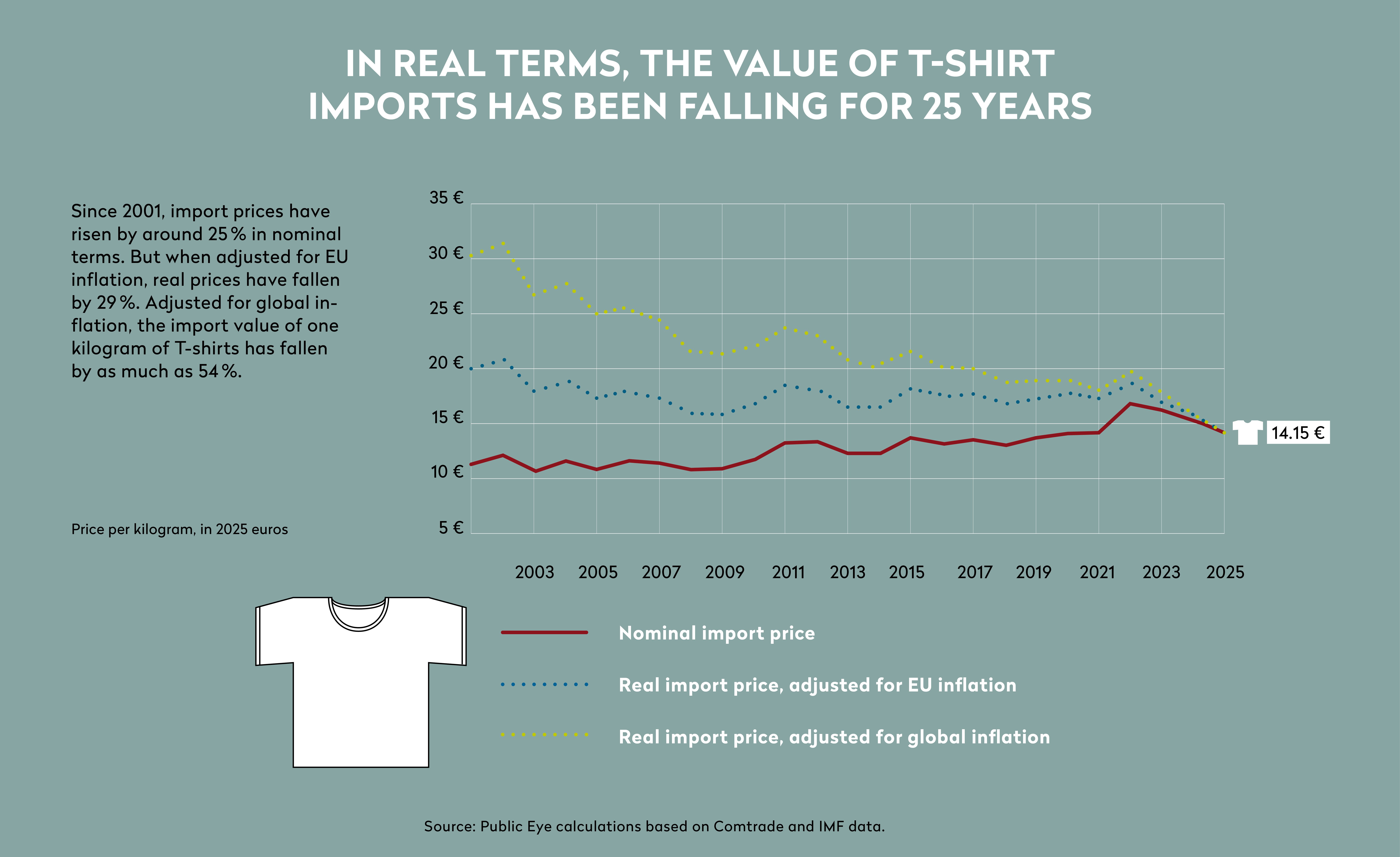
Overall, price levels have remained very low. In 2025, the average EU import price stood at just USD 16 (EUR 14.15) per kg. Import prices from Bangladesh, the main supplier to the EU, were even lower at around USD 13 per kg. That is equivalent to roughly EUR 11 for one kilogram of new T-shirts – a strikingly low price.
For comparison, the lowest prices for a basic T-shirt at major fashion retailers in Switzerland range from around CHF 9 to CHF 17 (EUR 10-19). In other words, the revenue from selling a single T-shirt at retail can be enough for major brands to buy about one kilogram of them at factory level.
Between 2001 and 2025, the world economy grew on average by around 3% per year, and global inflation led the average household living costs to more than double. In contrast, long-term data for EU T-shirt imports display only a meagre nominal purchasing price increase of 0.9% per year during the same period. When adjusted for EU inflation, this development translates into a real price erosion of −1.4% per year.
Nominally, EU buyers today pay roughly a quarter more for cotton T-shirts sourced abroad than they did 25 years ago. But in real terms, they are paying 30% less.
When adjusted for global inflation, the decline in real sourcing prices deepens to −3.1% per year, meaning that average sourcing prices have fallen by roughly half in real terms. This reflects a deliberate competitive reliance on ultra-low price points in mass-market apparel. This is not a statistical anomaly. It reflects a business model built around persistently low prices in the mass market for clothing.
The chase for the cheapest needle
The geographical pattern of trade illustrates how buyers have shifted sourcing towards locations that offer the lowest prices at scale. In the EU – the world’s largest import market for T-shirts – Bangladesh has become the dominant country of origin, reflecting its role as a global hub for large-volume, low-price knitwear. In 2025, 61% of T-shirts imported to the EU were sewn in Bangladesh. This is not diversification. It is a deepening concentration around the lowest-cost production base, reinforcing dependency on both sides of the relationship.
The pricing practices of leading buyers
Public Eye had access to company-specific trade data. These reveal that purchasing prices among the largest fashion companies are clustered within a relatively limited – and above all low – range, despite notable differences in market positioning.
Even among higher-paying companies – such as Fast Retailing (Uniqlo) or Bestseller with brands such as Jack & Jones and Vero Moda – sourcing prices from Bangladesh rarely exceed USD 18 per kg (about USD 3 per piece). At the lower end are discounters such as Primark and the Polish group LPP, sourcing at substantially lower levels or around USD 10 per kg., while Inditex and H&M fall somewhere in the middle.
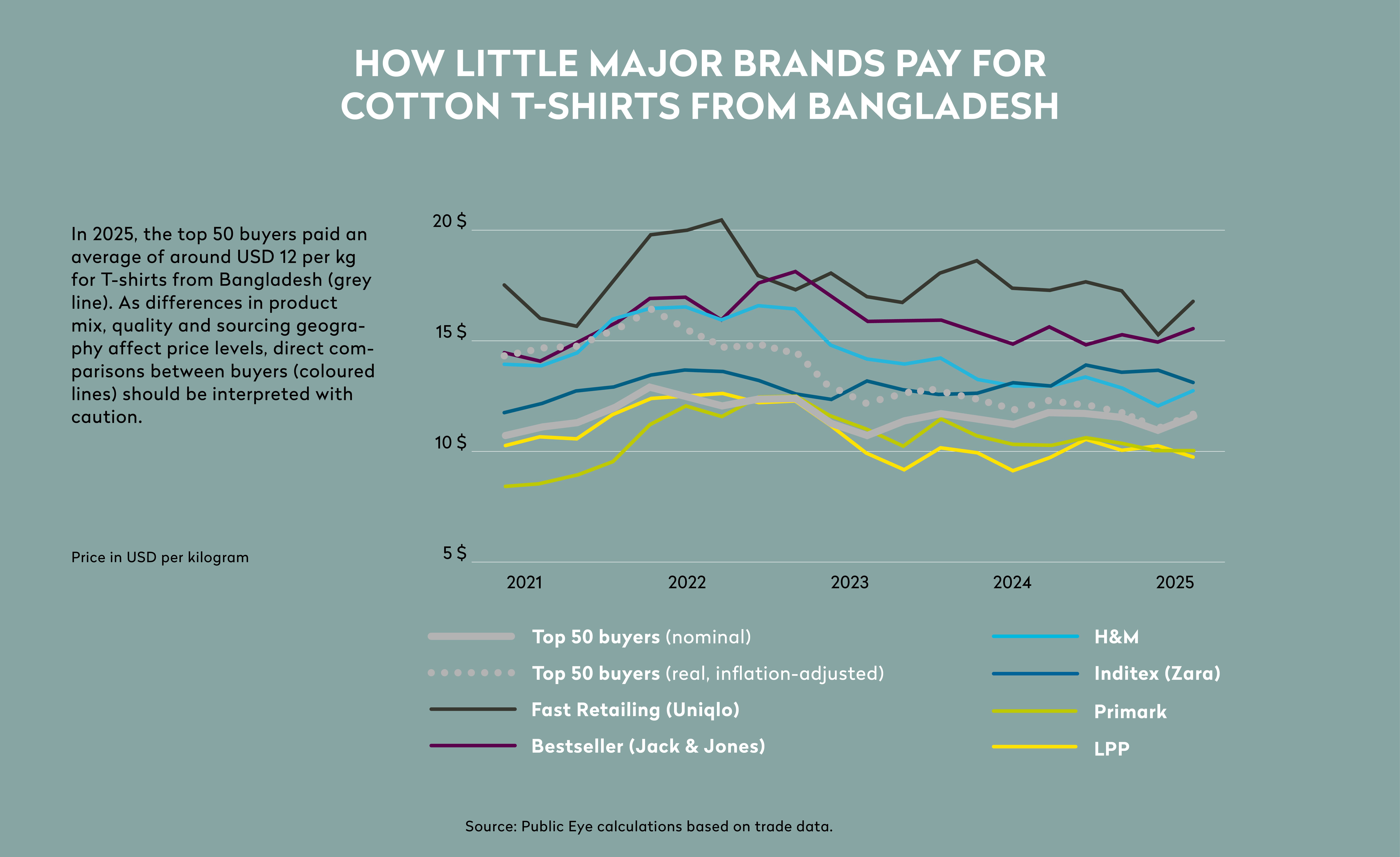
Company-specific price data were shared with major buyers. In response, some companies questioned the figures, arguing that average price metrics overlook key factors such as product mix, efficiency gains and cost drivers, while none provided alternative pricing data.
Read responses from major brands.
Noteworthy is the selective price elasticity in the market. When raw-material prices spike, sourcing prices can rise temporarily and buyers may absorb increases. However, wage increases do not have comparable weight. Even significant minimum-wage adjustments in Bangladesh have not translated into sustained uplifts in export prices. Energy shocks had a partial impact during 2022, but this faded as commodity conditions normalised.
The pattern is clear: suppliers can sometimes pass on higher material costs, and buyers are willing to absorb them. Labour costs, however, do not have comparable weight. Moreover, suppliers cannot sustain elevated price levels beyond the duration of the underlying commodity surge.
The power game of price negotiations
Interviews with merchandisers, production managers and buying-house specialists in Bangladesh shed light on how pricing pressure is applied in day-to-day negotiations. Many interviewees describe a process in which buyers enter discussions with fixed target prices and expect suppliers to match them regardless of rising costs or compliance requirements. Suppliers report systematic benchmarking against the lowest available option across countries, limited scope for negotiation, and recurring tactics such as last-minute concessions or attempts to renegotiate prices even once production is under way.
Margins on basic T-shirts are described as razor-thin and increasingly unstable. To avoid idle production lines, retain staff and protect cashflow, many factories accept orders at or below cost – particularly in off-peak months.
As nominal prices stagnate while other costs rise, suppliers are systematically pushed towards the most “flexible” lever left: labour. This translates into intensified work, extended hours, and sustained wage suppression. Ultra-low prices therefore lock in poverty wages, weaken factories’ ability to absorb shocks, and crowd out investment in social and environmental improvements.
Bottom-up pricing instead of top-down pressure
Two decades of voluntary standards, codes of conduct and multi-stakeholder initiatives have not corrected the structural undervaluation embedded in garment sourcing. Pricing must become a core lever of responsible purchasing and human rights due diligence. A shift from top-down to bottom-up pricing is central to this. Prices should be built from the real costs of compliant, rights-respecting and environmentally responsible production, rather than negotiated down from retail targets and margin expectations.
On this basis, the report explores minimum price targets as both normative guidance for negotiations and a practical instrument to anchor responsible purchasing in company practice. For cotton T-shirts, an interim benchmark could help lift the lowest prices towards market-average levels and slow harmful relocation dynamics. A preliminary benchmark proposal in the order of USD 30 per kg (roughly USD 5 for a 165 g T-shirt) illustrates the order of magnitude of change required to create space for living wages, safe and non-stressful work organisation, and credible environmental performance.