

Five achievements of our Chiquita campaign so far
Robert Bachmann, November 10, 2026
1. Chiquita’s door has opened a crack
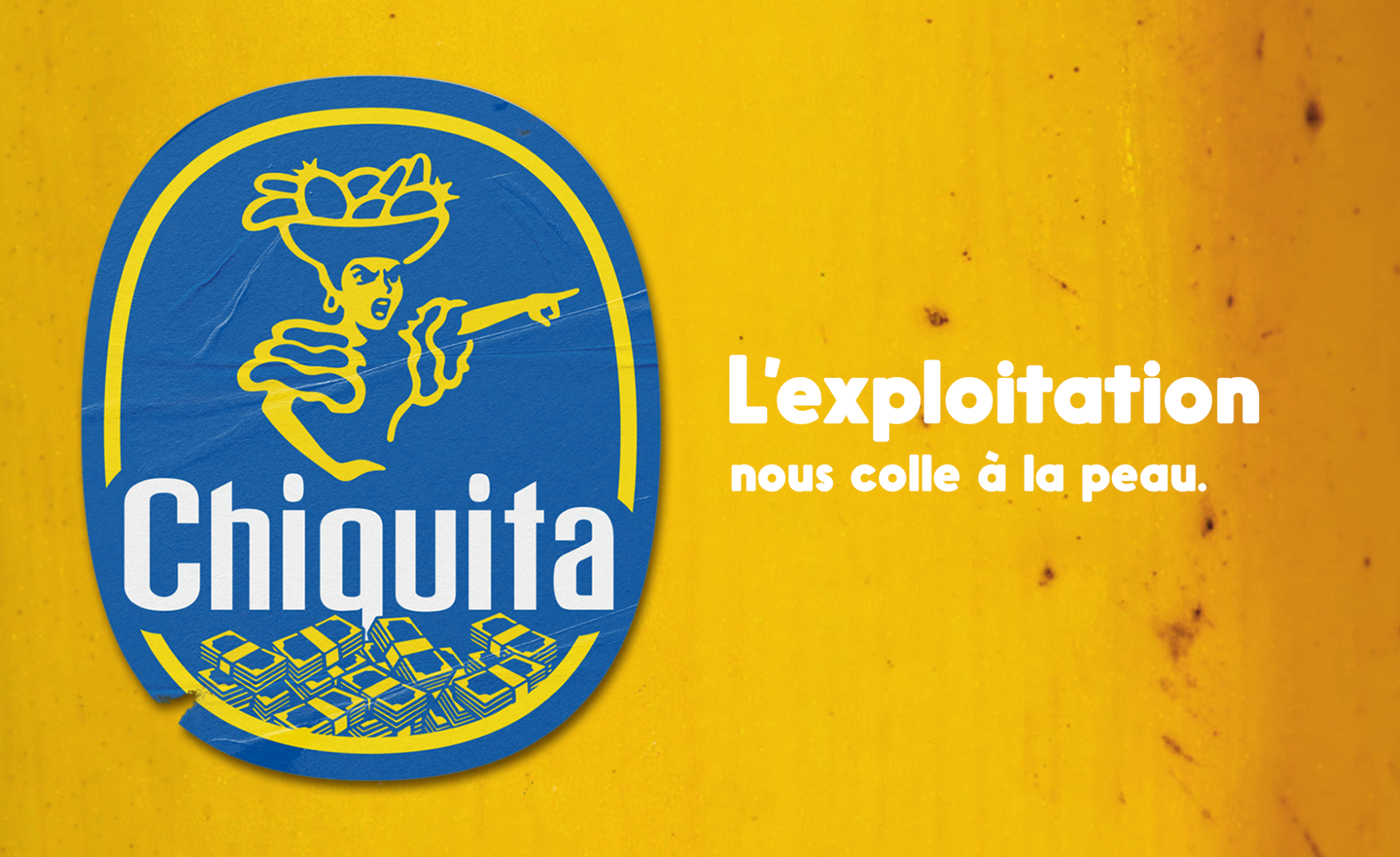
From the outset of our investigation, it was clear that a response from Chiquita was unlikely. Since its takeover by two dynastic Brazilian billionaire families – the Safras and the Cutrales – and its privatisation a little over 10 years ago, the public has learned virtually nothing about the brutal reality of banana production. Instead, the ever-smiling and ubiquitous Miss Chiquita remains the public face of the industry. We never received a response to the 48 questions we sent before publishing our report from Guatemala, nor did the corporation comment on the allegations to a dozen Swiss and international media outlets who covered the story. During our five-month campaign, supported by the many Public Eye volunteers who helped us to reach citizens across (almost) all of Switzerland, the corporation didn’t budge an inch. But when we protested outside its headquarters in the canton of Vaud at the end of September, the door finally inched open, and Chiquita’s Global Director of Sustainability accepted the 28,241 signatures. It’s a small victory, but alone it achieves nothing. Chiquita must now show genuine commitment to improving working conditions for people on its supplier plantations – and that is where the trade unions come in.
2. Trade unions are working hand-in-hand to fight for their rights
Since 2001, Chiquita has maintained a global agreement with COLSIBA, the coordinating body of Latin American banana workers’ unions, and the international trade union federation IUF. Under the agreement, Chiquita undertakes to respect the rights of workers and trade unions and to enforce them at supplier plantations, as well. This agreement provides for meetings every six months to address abuses. After a long suspension, talks resumed this summer. The trade unions were able to use the pressure generated by our report and campaign to get the process moving again. High on the agenda now is the situation in southern Guatemala, where an independent trade union was formed for the first time ever in 2024. From the outset, its members were intimidated, dismissed, bribed and even threatened with murder. The repression and climate of fear were so severe that the union had to call it quits. But the committed workers in Guatemala refuse to be intimidated and are receiving support from many other trade unions and organisations acting in solidarity across Latin America and beyond. In early October, we met them in Madrid to discuss the next steps. It’s important that pressure from all sides be used to persuade Chiquita to use its full market power to ensure that statutory rights relating to occupational health and safety, minimum wages and freedom of association are also respected on supplier plantations.
3. Rainforest Alliance conducted an audit of one plantation operator
The Rainforest Alliance label (the one with the green frog) is unpopular with trade unions on banana plantations. They say its certification and inspection processes are inadequate and have no meaningful consequences, particularly when it comes to protecting freedom of association. In response to our investigation in Guatemala, Rainforest Alliance conducted a multi-day audit of a major plantation operator outside the port city of Puerto San José in southern Guatemala in May. The auditors confirmed two of the three abuses we had uncovered, notably that the national minimum wage is not paid on the plantations and that aerial pesticide spraying takes place without adequate protective measures. We were disappointed that the auditors reportedly found no violations of freedom of association, as these were well documented. Still, the operator’s certification was suspended for 90 days as a result of the audit. After the 90-day period had expired, Rainforest Alliance informed us that the plantation operator had implemented measures to address the abuses. If a follow-up audit is able to confirm said measures, the operator could regain its certification. According to our local sources, the business has since been sold, in what appears to be an illegitimate transaction, without any actual change of ownership. This loophole, it seems, allows them to replace the workforce and dismiss unwanted staff. Rainforest Alliance also confirmed that this purported sale kept two of the plantations outside the scope of the audit, which helped them retain their certification. In positive news, as of 2027, the green frog label will extend all audits of Guatemala's banana plantations by one day and conduct off-site interviews with workers “in order to obtain better quality information on the situation on the ground”.
4. Migros removed a misleading sustainability claim
At the beginning of the year, we asked all major Swiss retailers whether they sold Chiquita bananas. Coop and Aldi said that they do not, while Lidl evaded the question. Migros and its subsidiary Denner were the only retailers to confirm that they source Chiquita bananas, although the company claimed that they came from Panama rather than Guatemala. Shortly afterwards, we sent Migros a photo of a Guatemalan banana found in one of their branches. The company backtracked and replied that bananas from Guatemala were sourced only in exceptional cases when supplies were short. A Migros employee also informed us – and we would like to thank him warmly here – that the low-budget line “M-Budget” bananas also come from Chiquita. These are even advertised with the claim “Responsibly grown” – a claim based on Rainforest Alliance’s certification. Migros should know that the label is anything but a guarantee of responsible cultivation, and that growing conditions in Chiquita’s supply chains are highly problematic in every country. Excluding just one single country achieves little. Migros told us that it was holding talks to gain a better understanding of due diligence obligations, certification processes and monitoring mechanisms at Chiquita and Rainforest Alliance. Migros should fundamentally reconsider its business relationships with both. Early signs are that there has at least been an initial acknowledgement of the problem: Migros removed the claim that Rainforest Alliance-certified M-Budget bananas are “responsibly grown”.
5. A young podcast listener turned down a job offer from Chiquita
At the end of the summer, we received a message from a young listener to our French-language podcast, who informed us that he had decided to turn down a job offer from the corporation after learning about Chiquita’s business practices through our reporting. We can only congratulate him on taking such a clear stance, and we do not think he will regret it. When we demonstrated outside Chiquita’s headquarters in Etoy at the end of September, we didn’t get the impression that inside the building was a hive of activity. Rather, it seemed that the corporation maintains the minimum presence necessary to benefit from the Canton of Vaud’s low-tax regime.
At Public Eye, we will keep up the pressure to achieve tangible improvements for people on the ground by talking to those affected in Guatemala and to trade unions, mobilizing international networks, putting pressure on the corporation and pursuing political action. Thank you for your support!