

Corruption Oil mega-deal in Gabon: Gunvor once again in the sights of the Swiss justice system
Agathe Duparc, June 2, 2026
In the trade, people now talk about the “new Gunvor” or “Gunvor 2.0”. The labels speak to the scale of the changes that hit the Geneva-based trading house in 2025. The departure of around 15 employees, surprise retirement of the group’s number two and reorganisation of teams, not to mention the abandoned plan to buy the international assets of Russian giant Lukoil after the US Treasury accused Gunvor of being “the Kremlin’s puppet” made for a turbulent year. That sequence came to a close in December with the departure of chief executive Torbjörn Törnqvist. At 72, the longstanding shareholder handed over all his shares (86 percent of the capital) to a group of senior executives and was replaced by Gary Pedersen, who has the added advantage of holding a much-desired US passport.
New look, old skeletons in the cupboard
At the end of 2025, in response to mounting speculation across the sector about Gunvor’s future, the trading house’s communications team stressed the need for a “definitive reset […] for a company for which misperceptions about its past have become an impossible distraction”. It was a nod to the persistent suspicions of closeness to the Kremlin, which stem from the group’s Russian roots. (Gunvor was co-founded by Gennady Timchenko, a close associate of Vladimir Putin.) The rebrand also invoked a “generational shift”.
As Public Eye has been able to reconstruct, this major “reset” also came as Gunvor was going through a serious internal crisis. Internally, deeply embarrassing details were beginning to emerge related to the particularly opaque inner workings of the oil market in Gabon. This led Switzerland’s Attorney General to order a search of Gunvor’s Geneva headquarters in mid-May, as we have learned. The federal prosecutor confirmed the search to Public Eye, noting it was conducted “as part of a criminal investigation opened against unknown person(s) on suspicion of bribery of foreign public officials (Art. 322septies SCC)”, in connection with oil contracts in Africa, notably in Gabon.
“We cannot comment on your claims. We firmly believe you are misconstruing information” replied Gunvor, adding that, as part of an “internal investigation”, “Gunvor further did not identify any corruption or bribery related to the Assala deal”, which was “undertaken with the most stringent levels of compliance”.
This latest episode could prove disastrous for the group, which has already twice been convicted for “organisational shortcomings” linked to corruption. The first of these came in Switzerland, in 2019, over oil contracts in Congo-Brazzaville and Côte d’Ivoire. A second followed in 2024 – this time in Switzerland and the United States – for bribes paid in Ecuador. Under a “Plea Agreement” reached with the US authorities, the group then committed to follow strict compliance procedures. If it fails to do so, it risks fresh sanctions.
A billion-dollar loan and medals handed out in Gabon
In June 2024, the trading house pulled off a masterstroke, establishing itself as a strategic partner of the Gabonese state and its new president: coup leader General Brice Clotaire Oligui Nguema. Nguema came to power in August 2023, after more than half a century of rule by the Bongo family. Since, he has made “taking back control of national resources” his watchword.
The background to this oil mega-deal has already been in part revealed by specialist news outlet Africa Intelligence in a two-part investigation. Public Eye has been able to substantiate and complete the picture with new material from its own inquiries.
Fending off rivals Vitol and Trafigura, Gunvor then granted a one billion US dollar loan to Gabon Oil Company (GOC). The operation enabled the Gabonese state oil company to acquire the assets of Assala Energy, one of Gabon’s main oil producers, from US fund Carlyle. It thereby took control of its six oil blocks, which produce more than 45,000 barrels a day, or between 20 and 25 per cent of the country’s output. In return for this loan, repayable over five years, Gunvor secured exclusive rights to market the crude extracted from those blocks, as well as the barrels obtained by GOC in its capacity as a shareholder in other oil fields (cost oil). A real jackpot.
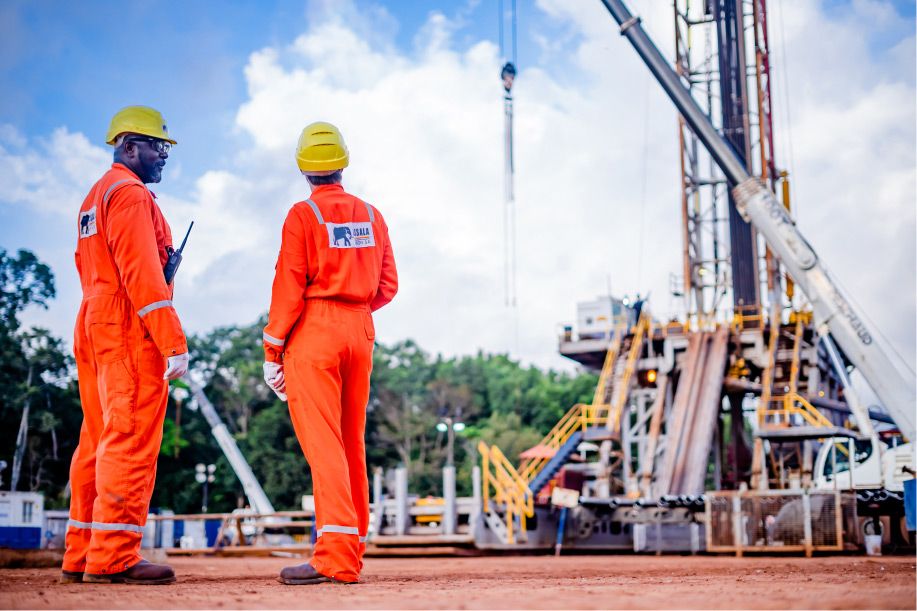
The contract signed between Gunvor Middle East DMCC (the group’s Dubai subsidiary) and GOC, a copy of which Public Eye has obtained, provides for the lifting of at least 58 million barrels by April 2029, with a margin of 0.10 dollars a barrel, excluding transport and logistics costs. Africa Intelligence calculated that Gunvor’s profits, including interest payments on the loan, could reach 200 to 250 million dollars over five years. With oil prices soaring, these are likely to be even higher.
“Gunvor is proud to have been selected as Gabon’s partner for this strategic acquisition,” said Stéphane Degenne, a member of Gunvor Group’s Executive Committee who supervised the whole operation. Six days later, the senior executive was made an officer of Gabon’s National Order of Merit by President Oligui Nguema, alongside two other Gunvor employees.
An advisor pops up
That enthusiasm abruptly faded when, on 16 January 2025, the same Degenne received an email headed “URGENT: formal notice”, copied to Marcellin Simba Ngabi, GOC’s chief executive. The message, which we have seen, was sent by Mohamed Dagdag, a French-Moroccan businessman, who notes “a worrying delay in the settlement of fixed fees and success fees” linked to his assignment. His company, Vakana Invest, based in the United Arab Emirates and Morocco, specialises in investment advice. According to him, it played a “decisive role in facilitating the financing of the Assala Asset”, “as a leading advisory player combining political lobbying, strategic advice and technical representation with stakeholders”. Dagdag has threatened to trigger “legal proceedings” if his requests for an amicable settlement go unanswered, adding that he has already instructed several law firms.
The email refers to a “legal notice” filed with Dubai Court. Drafted in Arabic and English, the document, which we have seen, states that Gunvor owes him 13.238 million US dollars. A sum that would now total more than 16 million, including late fees.
Is this a bluff, frequent in major oil deals, which tend to attract all types of adventurous characters? Or, on the contrary, is it proof that despite its public commitments, Gunvor has continued using intermediaries?
Zero tolerance
At the end of 2020, joining other traders such as Trafigura and Glencore, the group publicised its decision to stop using agent services. These intermediaries or consultants are prized for their information and their ability to open doors in certain markets, sometimes at the cost of less savoury practices, such as paying bribes to officials. In Ecuador, the Swiss and US authorities were able to show that Gunvor had greased the palms of senior Ecuadorian officials through two Ecuadorian-Spanish oil consultants, whose exploits Public Eye has previously recounted.
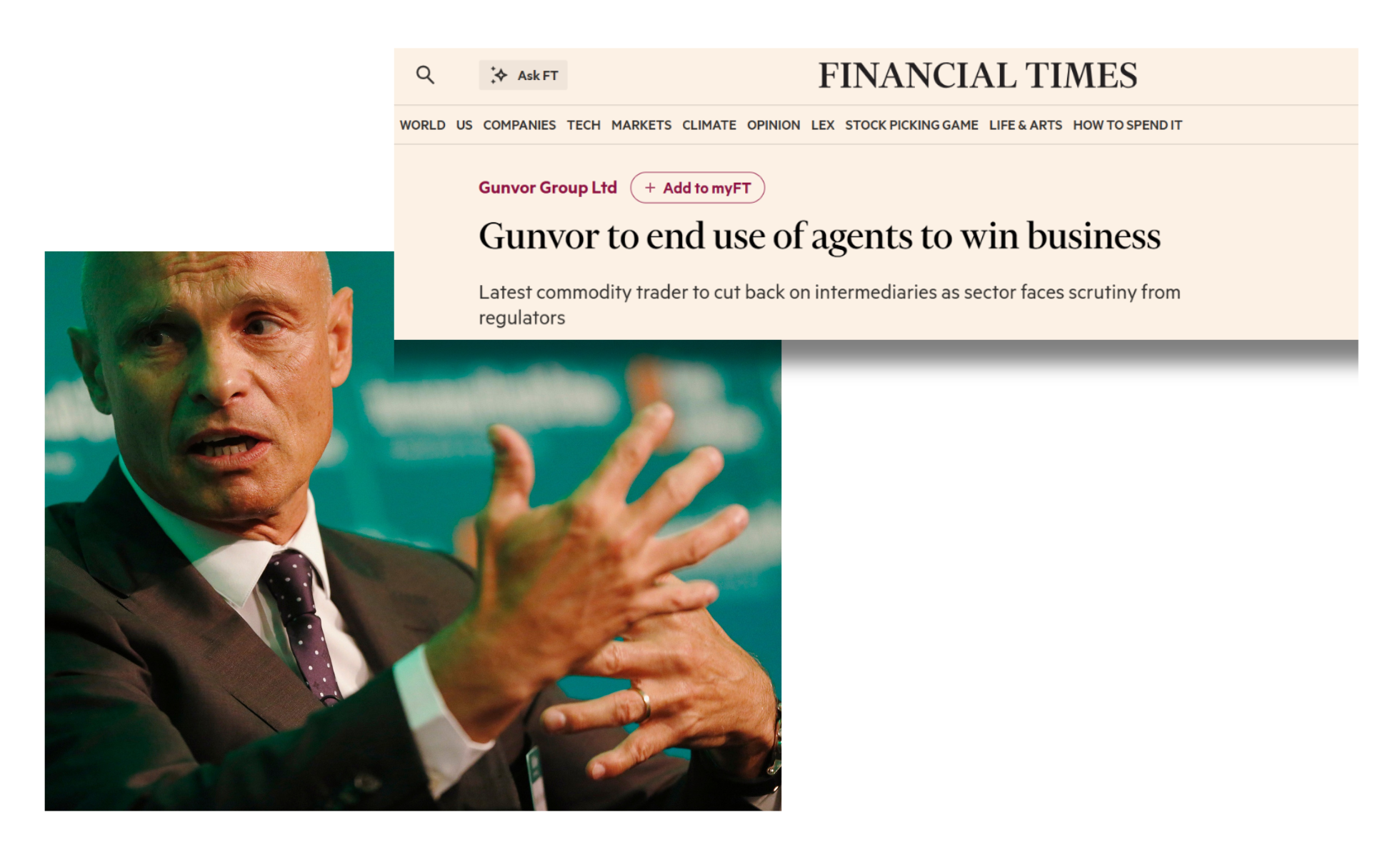
Referring to the “lessons of the past”, chief executive Törnqvist explained the decision, promising that the company would now do everything possible to ensure that its “zero-tolerance Compliance policies” were applied. “If we lose business as a result, so be it”, he added, magnanimously.
According to our information, that line does not appear to have been respected in Gabon.
A meeting with the president
Several pieces of evidence suggest that Dagdag, the French-Moroccan businessman, did indeed play a facilitating role in securing the contract – at least during the project’s initial phase.
As Africa Intelligence has revealed, and as we have been able to confirm, Dagdag himself worked to arrange a dinner in Paris in January 2024 attended by two Gunvor employees, including Guillaume Letessier, then head of Africa development and director of Gunvor Middle East DMCC in Dubai. Letessier worked under Degenne, the member of the Executive Committee. The aim was to introduce them to a very valuable contact: former Gabonese vice-president (2017 to 2019) Pierre-Claver Maganga Moussavou, who at the time had a “special mandate” from the president to look for investors.
Ten days later, the Gabonese presidency sent a letter of invitation to the two Gunvor staff who had taken part in that dinner, as well as to a third employee from the group. It stated that Gunvor “expression of interest in a partnership for investment projects in Gabon” had been passed on to President Oligui Nguema “through Mr Mohamed Mao Dagdag”.
Later, on 15 February 2024, Letessier was received at the presidential palace, alongside the former vice-president and Dagdag. He went alone, even though an internal rule – still informal at the time – within Gunvor required meetings with politically exposed persons (PEPs) to be attended by two people. The discussion focused mainly on financing the acquisition of Assala’s assets, but road construction projects backed by Vakana were also discussed.
The Gabonese presidency appears to have been satisfied. It relayed the meeting on social media, publishing several photographs as well as a YouTube video in which the Gunvor employee spoke briefly. Several Gabonese media outlets also picked up the story.
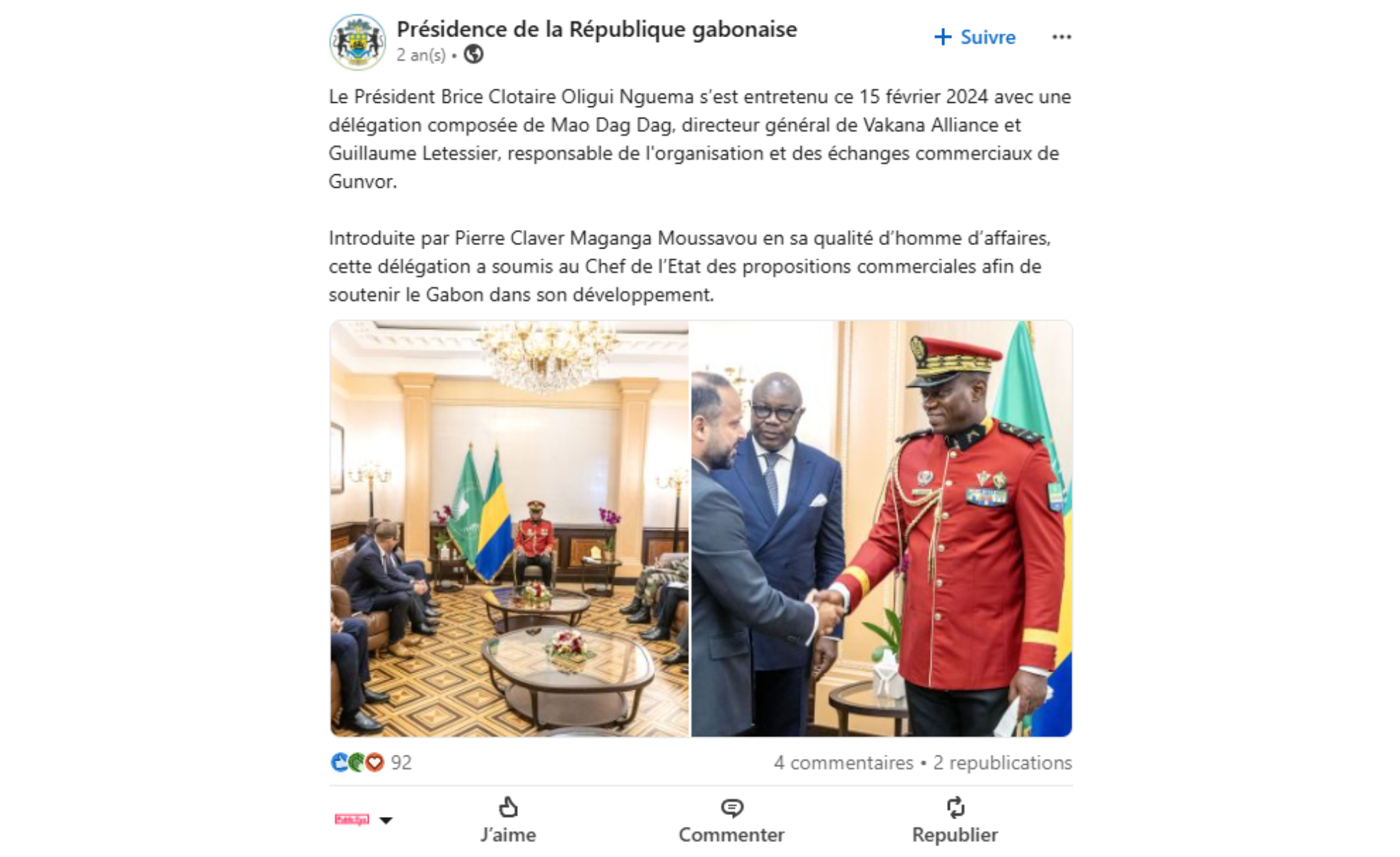
Four days later, the Gabonese presidency sent an invitation to Gunvor top boss Törnqvist: “I have the honour to invite you to stay in Libreville from 21 to 25 February 2024 in order to continue discussions relating to your partnership offer,” reads the letter, which again refers to the intermediary role played by Dagdag.
The meeting never took place, but the case moved ahead at great speed. As Africa Intelligence has reported, Gunvor continued negotiations with GOC chief executive Marcellin Simba Ngabi and ultimately clinched the deal.
One question in this episode remains: Did the French-Moroccan advisor continue to be involved right up to the disbursement in June 2024 of the 1 billion dollar loan?
A contract for services
Dagdag claims that a framework agreement was concluded between Gunvor Middle East DMCC and Vakana on 14 February, the day before the presidential meeting. Under this 12-point contract, to which Public Eye has had access, VAKANA Investment in Commercial Enterprises & Management Co. LLC (the company's full name), represented by Dagdag, undertakes to provide advisory, analytical, and technical assistance services in connection with the Assala project. Article 2 sets out payments ranging from 3,400 to 5,100 dollars per day, and if the deal is signed, a success fee of “1.25 per cent (excluding VAT) of total investment made in oil and energy assets”.
The agreement provides that Vakana may use third parties – or subcontractors – to deliver services. It also states that Gunvor may use other commercial entities to pay Vakana and its representative. This so-called “third-party payer” practice is not illegal, but it remains opaque. Marked “confidential”, the document bears the stamp of Gunvor Middle East DMCC as well as the signature of its then director, Letessier. It was mentioned a few months later in the filing submitted to the Dubai Court.
According to our information, Gunvor subjected Dagdag and his company to a Know Your Customer (KYC) procedure. In an exchange of emails dated 16 February 2024 that we have also seen, the person overseeing these operations in the compliance department asks the French-Moroccan businessman to provide a list of documents concerning Vakana and its activities. As we have learned, the businessman was known to the group. According to our information, he had already been subjected to this procedure a few months earlier because of his involvement in a small oil deal in São Tomé that never materialised.
Expenses routed through a shipping agent
The payment issue arose very quickly. In a WhatsApp exchange dated 9 February 2024, a few days before the meeting with the Gabonese president, Dagdag mentions hotel and air travel expenses incurred by Vakana for the trip to Libreville to Letessier, as well as “mission representation expenses (me)”. “Send me one overall invoice, I’ll have it paid elsewhere. Address it to New Maritime DMCC,” the Gunvor employee replies.
Based in Dubai since 2017, New Maritime DMCC is the main arm of New Maritime Group. Its headquarters had initially been registered in Geneva in 2015, where it still maintains a presence. Well known in the trading world, the group provides standard shipping agency services, such as overseeing the berthing of cargoes, as well as paying quay and harbourmaster fees, and records management.
According to our information, Clearlake Shipping – Gunvor’s maritime transport subsidiary, which charters tankers – regularly uses New Maritime DMCC. In April 2022, for example, the shipping agent sent an invoice to Clearlake Tallin for more than 132,000 dollars, payable into its UBS account in Carouge, Switzerland for the unloading of a petroleum products tanker at the port of Walvis Bay in Namibia. However, it does not appear to be part of its mandate to pay an advisor who has provided services to Gunvor.
Public Eye has seen an invoice dated 22 February 2024 sent by Vakana to New Maritime DMCC for a total of 51,250 euros, comprising 20,000 euros for “advice and strategy/lobbying”, 22,750 euros for “air travel, transport, taxi hotel”, and 8,500 euros in VAT. It was followed by a reminder invoice dated 2 March.
The invisible intermediary
This is where the machine appears to have jammed. As we have learned, Gunvor’s compliance department in Geneva became increasingly concerned about the reputational consequences of the first meeting in February 2024 at the presidential palace. The publicity of this meeting had not been planned, and the trader is said to have been presented with a fait accompli. In the photographs, Dagdag can be seen shaking hands with the president, alongside the Gunvor employee, who stands in the background. This alone is enough to raise questions.
Gunvor reportedly decided to protect itself, asking him to sign a waiver letter, with a promise to find another way to pay him. They allegedly used a powerful argument to persuade him: not provoking the wrath of the US Department of Justice (DOJ), with which Gunvor signed a plea bargain when it was convicted in March 2024 in the Ecuador case. The trading company had to pay a fine of more than 661 million dollars. It undertook to strengthen its compliance program and its internal controls, ensuring that it complies with the 23 points set out in a document entitled “corporate compliance program” in Annex C of the plea bargain. It must also report annually on the progress made over a period of three years. If it fails to comply, Gunvor could expose itself to an extension of this monitoring obligation, or even fresh proceedings in the event of a repeat offense.
The agreement was signed off at the highest level by Degenne and Jean-Baptiste Leclercq, head of the legal department (CLO). The use of an “agent” or “business partner” is not prohibited in the 23-point annex, but it must come with robust safeguards “where necessary and appropriate”. These include regular training, anti-corruption declarations and written undertakings in contracts, or the right to carry out “audits of the books and records of the agent”. Yet none of this appears to have been put in place with Dagdag.
The businessman eventually gave way: on 5 April 2024, in a letter addressed to Gunvor SA, a copy of which we have seen, Dagdag certifies that neither he nor his company Vakana “are acting, or acted for and on behalf of Gunvor SA or any its affiliates/Subsidaries”, and that they have never “been proposed to work as an intermediary for Gunvor Group and thereby no benefits, even indirect in the future, have been proposed to Us”. He attached a copy of his passport to that letter.
Invoices through shell companies
The situation is paradoxical. On the one hand, there is a services contract between Vakana and Gunvor Middle East DMCC; on the other, a duly signed waiver letter sent to Gunvor SA states that the French-Moroccan businessman and his company have never worked for the group, have never received any offer and have not been paid a penny.
Dagdag continues to demand payment of his expenses, but he now does so through offshore companies – a way of masking his identity. On 10 May 2024, Blueco Ship Management PTE LTD, based in Singapore, invoiced New Maritime DMCC for 25,000 US dollars, payable into an account at Standard Chartered Bank (Hong Kong) LTD, with “Commercial marketing and Logistic Services” given as justification for the period from January to March 2024.
But things dragged on. At the end of May 2024, in an exchange of emails of which we have a copy, Dagdag complained to the head of New Maritime that he had not received a promised payment. On 6 June 2024, he sent him six invoices bearing the names of different companies, including Blueco.
According to our information, he received nearly 70,000 dollars through this opaque mechanism.
A letter from a Geneva lawyer
The advisor did not stop at these relatively modest sums. Once the oil agreement with the Gabonese had been signed, Dagdag asserted financial claims worth millions of dollars to Letessier, his main contact. Despite the waiver letter of 5 April 2024, he did not hold back, three months later, from publishing a press release praising the role played by Vakana in the Gabon deal, illustrated with two photographs. The text can still be viewed on his LinkedIn account.
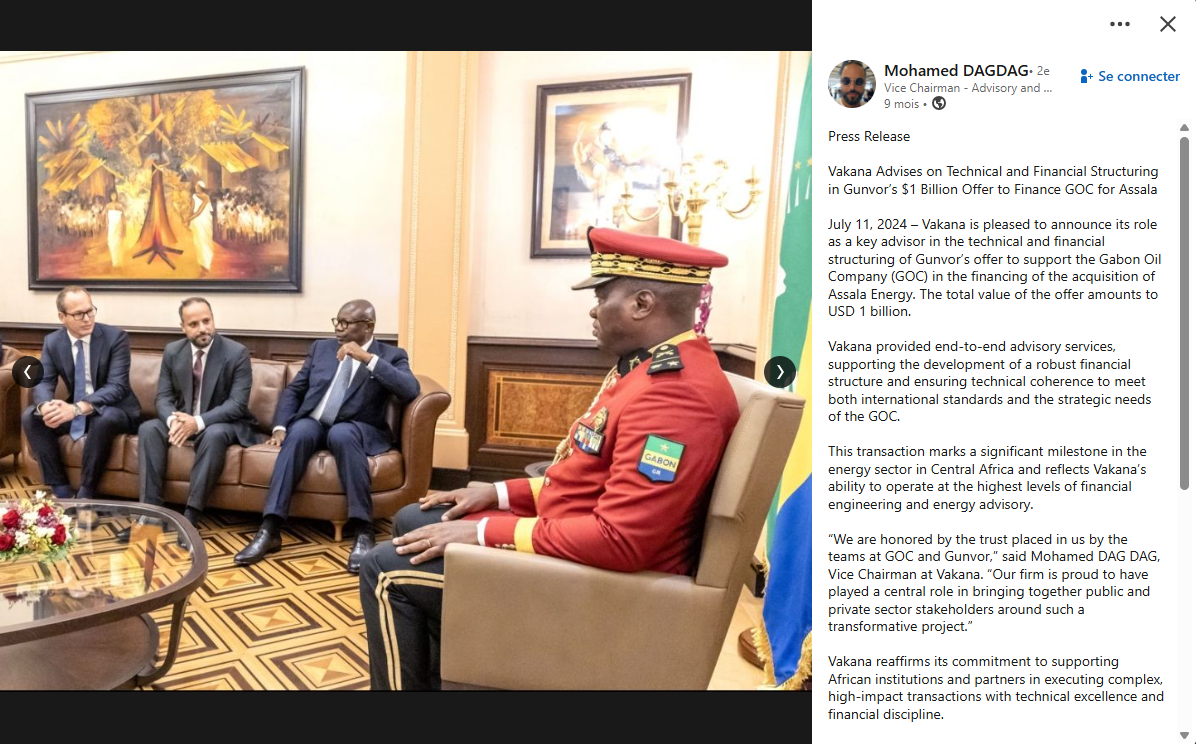
Dagdag also retained the services of a Geneva lawyer. In a letter sent on 20 November 2024 to Letessier’s private email address, the Swiss counsel wrote: “My clients [editor’s note: Vakana Investments in Commercial Enterprises & Management CO. L.L.C and its representative Mohamed Dagdag] inform me that they have claims for remuneration against Gunvor in connection with the acquisition of the ‘Assala’ oil asset; they have a strong and documented file, consisting mainly of WhatsApp exchanges, audio messages and witness statements.” The letter refers to the possibility of approaching “Gunvor’s team in Geneva”, including Törnqvist and Degenne, directly, as well as the “competent judicial authorities”.
Panic at Gunvor
According to our information, Degenne was informed of this letter and advised his subordinate not to alert the compliance department and instead to push back Dagdag’s requests with the backing of the Gabonese president. This was made more urgent by the fact that, as Africa Intelligence has revealed, two other intermediaries with rather dubious pedigrees had also come forward demanding their due. The others eventually dropped the matter, unlike Dagdag. Then, in January 2025, the dispatch of the famous “formal notice” lit the fuse.
This time, it was Degenne who was forced to raise the alarm. The case was passed to the compliance department as well as to Leclercq, head of legal, who oversees the group’s “Law, Compliance and Ethics” programme. Having joined Gunvor in 2011, the lawyer had come through the two corruption scandals without apparent damage. Notably, he is chairman and director of Clearlake SA, the Geneva arm of Clearlake Shipping, which uses New Maritime’s services.
An internal audit was launched to determine whether the Gabon deal had been tainted by corruption. In early February 2025, Letessier was shown the door. Then, at the end of March, his superior Degenne – a pillar of the company since 2007, whose name had surfaced in the Congo and Ecuador cases without attracting the attention of prosecutors – announced his early retirement. This came as a surprise, as he is just 56. The head of structured finance, who worked on the Gabon deal, also resigned in June 2025. Finally, in July, Gunvor Middle East DMCC was nearly dismantled, with all of its senior staff resigning.
At the same time, around 10 people with no connection to the Gabon affair also left the group. The company’s communications described it as a “generational change”.
 ©
Keystone / Martial Trezzini
©
Keystone / Martial Trezzini
A parallel route for paying intermediaries?
Inside Gunvor, management remains on edge. Beyond the Gabon case, what could be brought to light is a broader system for bypassing compliance rules.
According to our information, New Maritime has in recent years been used to pay other intermediaries and commercial agents who were working discreetly for Gunvor. Several sources described to us how the system is said to have worked. New Maritime would invoice Clearlake Shipping – Gunvor’s shipping subsidiary – for unloading fees at an identified port. Those fees were allegedly inflated, with the difference retained by the shipping agent used to settle various invoices on Gunvor’s behalf.
In Cameroon, Gunvor is said to have used the services of a local intermediary tasked with helping to secure tenders for petrol volumes. In autumn 2023, the company he was using, Goods Services and Consulting FZCO, based in Dubai, sent New Maritime DMCC an invoice for 25,500 euros in consultancy fees payable to WIO Bank in Abu Dhabi. On 11 September 2023, his account was credited with that amount from New Maritime DMCC’s UBS account in Switzerland.
Contacted by telephone by Public Eye, this man, whom we only know by his first name, confirmed that he was working for Gunvor at the time and that he was in contact with Degenne and Letessier. However, he cut the conversation short when we asked him about New Maritime. Since then, he has been unreachable. We sent him a list of questions He didn't respond.
Until March 2025, Gunvor also worked with a South African intermediary whose full identity we are aware of. In an email to Gunvor from Spring 2025, he complained of having been sidelined from a major project, reminding the company of his “long relationship with Gunvor via multiple entities over the last eight years”. That relationship began in 2017. According to our information, this man was also paid via New Maritime. He did not respond to our requests for comment.
Taken in sum, these practices raise questions about the reality of the anti-corruption commitments the twice-censured group has taken, with a third set of proceedings in Switzerland impending. So much for “Gunvor 2.0”.
In response to our detailed list of questions, Gunvor sent the following statement, which we have reproduced in full: “Due to confidentiality obligations and lack of time provided to review, Gunvor is not in a position to address your questions. Suffice to say that certain statements you make contain erroneous information. We must reiterate that Gunvor ceased using commercial agents in November 2020 and through its compliance framework has strictly enforced that policy since. Following a thorough internal investigation, Gunvor affirms that the Assala deal was undertaken with the most stringent levels of compliance. We reserve all our rights with regard to this matter.”
In response to our questions, Guillaume Letessier said he did not wish to “comment on this matter”. Stéphanne Degenne did not respond to our requests.
When asked about his role, Mohamed Dagdag sent us the following response: “I was commissioned by Gunvor Middle East DMCC to assist them in Gabon as part of the Assala project, with the task of advising them on technical, commercial, and financial matters. The waiver letter mentioned in your questions was entirely initiated by Gunvor DMCC. I was instructed to sign it in order to receive payment in accordance with the contract terms. I now consider myself a victim, and feel my company has been completely wronged in this matter. Legal proceedings are currently underway, and I intend to fully assert my rights before the competent courts. In accordance with the advice of my attorneys, who have reminded me of the confidentiality clause in the 'Framework Agreement' signed with Gunvor. Given the status of the ongoing proceedings, I will make no further comments.”
When reached out to by Public Eye, former Vice President Pierre-Claver Maganga Moussavou said: “My role ended once I had put Gunvor in contact with the Gabonese state and ensured that everything was going well. I did not receive any remuneration.”
The director of New Maritime Group did not respond to our questions.